
Winter, 2026
Volume 3.1
CONTENTS
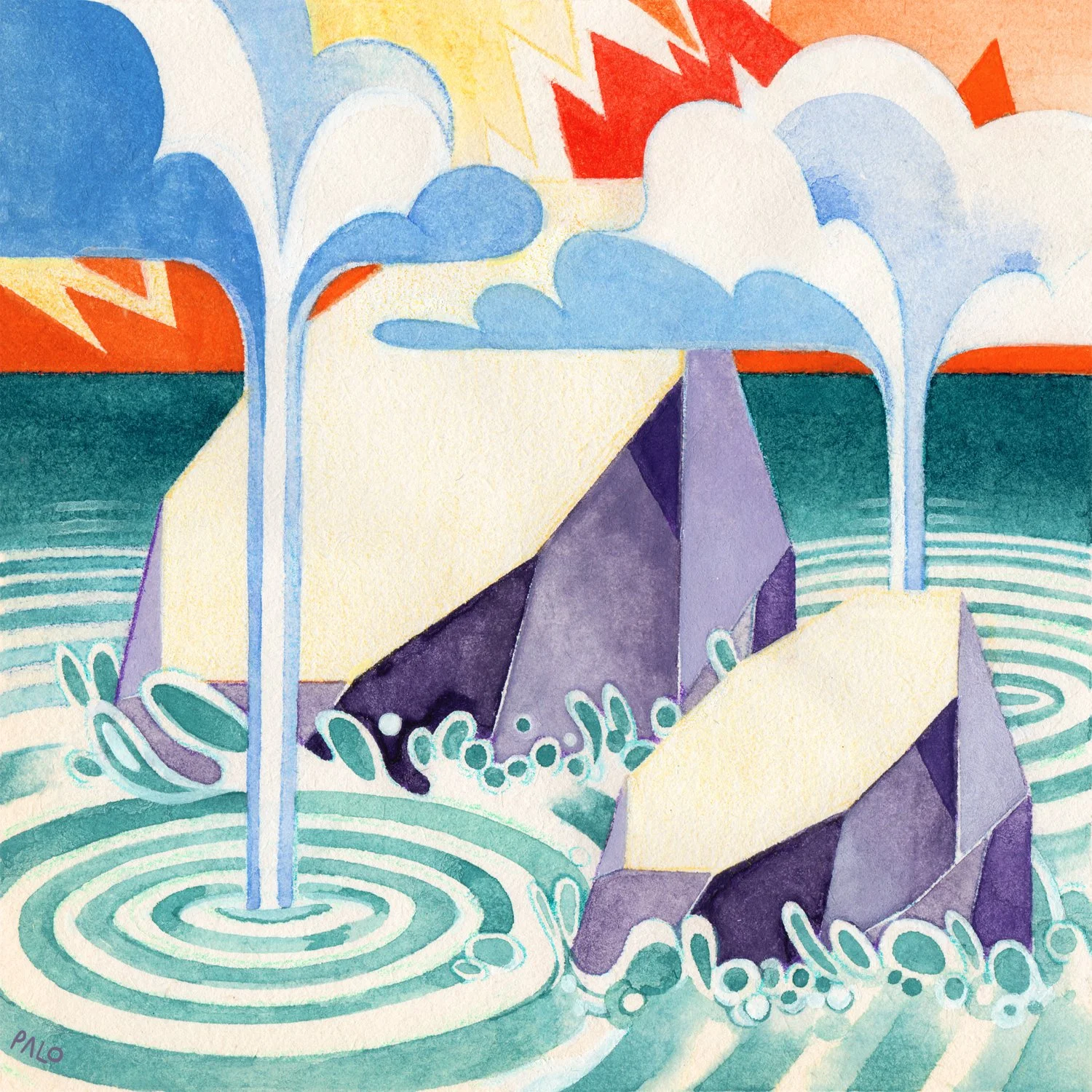
Birth of Stones by Pablo Andrés Palo
Letter from the Editors by Mahaila Smith and Libby Graham
The Ghosts Have Wi-Fi by Ivan Ndoma-Egba
To Carlotta, I leave my memories by Salena Casha
Where the Map Cut Through Our Bone by Lucien R. Starchild
Apocalypse, Yesterday by Manuela Amiouny
In Bloom by T.R. Steele
Bought, but Not Yet Paid For? by Lynne Sargent
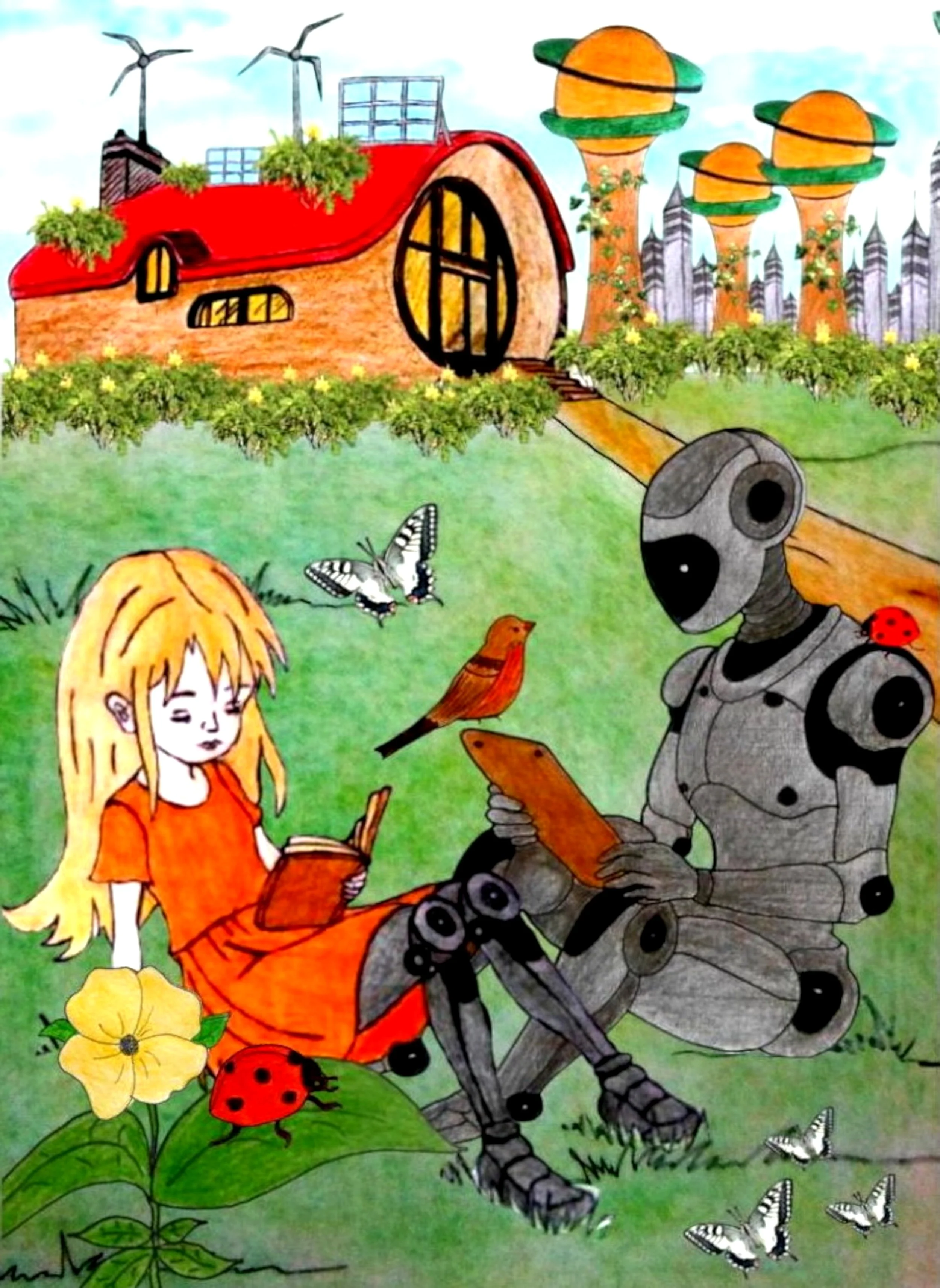
Solar Punk Farm by Viviana De Cecco
The Last Garden by Elizabeth Wanjiku
Umbra by Frances Boyle
Roots of Resistance by Andrew Maust
The Spontaneous Occurrence of Fig Bars by Teresa Milbrodt
the constancy of cats by Crystal Sidell
The Dispatches of Dr. Clara Weber and Sgt. Andres Ramírez by Yasmeen Fahmy
by Pablo Andrés Palo
The Birth of Stones
Pablo Andrés Palo is an Argentine artist, born in 1988. He began his career during his teenage years, working as an assistant to comic book and illustration artists, later devoting himself to his own personal path. He finds illustration to be a medium of infinite possibilities. He is inspired by humor, psychedelia, nature, mystery, human relationships, and everyday life.
For the past decade, he has worked as an art teacher at the higher education level. He has taken part in numerous awards, open calls, and artist residencies.
Letter from the Editors
Welcome back Sprawlers. It has been far too long since we last spoke. In Volume 3.1, we have chosen pieces that examine the tension between individual property rights and relationality.
Our volume begins with a poem by Ivan Ndoma-Egba. In it, he questions who has the right to access a relative’s data after they die. He writes, "My grandmother haunts a server farm / in Northern Ontario. / Sometimes, she speaks in buffering. / Sometimes, in Yoruba / I never learned to translate."
In his poem dedicated to the Akwesasne Mohawk at St. Regis Falls, Lucien R. Starchild examines Indigenous land rights and history, writing, "The St. Lawrence fingers through our ribs like a surveyor’s line, / Its currents thick with what General Motors left behind— / PCB sheen where our grandmothers once pulled sturgeon / Fat with stories. Now the EPA posts warnings in two languages, / Neither of them Kanien’kéha.”
Lynne Sargent's story reports on a court case in the near future in which a smart home firmly asserts its preference for the long term property manager's care over its owners. The story asks us to directly consider what constitutes property and whether "[i]t should be illegal on environmental grounds for goods—or in this case, property and construction—to be destroyed if it could instead be used in a beneficial way."
In Manuela Amioumy’s poem, the speaker moves through land rich with water she does not have. She writes, “I trespass on the green golf field next door / that fired [my mother] last month for stealing—three drops off a single blade of grass. / I run across the spitting sprinklers, barefoot on the moist lawn.” This poem is especially chilling as we veer ever faster towards a global water bankruptcy.
As in our previous volumes, this volume continues to examine our relationships to land. T. R. Steele's haunting story shows its speaker maintaining their relationship to a relative through a slope overlooking a creek. Elizabeth Wanjiku's story tells of gardeners in a post-apocalyptic Nairobi tilling the land under the ruins of the National Museum.
Our volume ends with Yasmeen Fahmy's unique piece told through the dispatches of extraterrestrial explorers. As Dr. Clara Weber and Sgt. Andres Ramírez travel across new lands, they illustrate the immense impact, good or bad, a person can have on their landscape.
We hope that you will be inspired by these stories, and take their messages with you into our world.
From our bit of space rock,

The Ghosts Have Wi-Fi
by Ivan Ndoma-Egba
They said her spirit never crossed . . .
glitched at the border
of bandwidth and burial.
My grandmother haunts a server farm
in Northern Ontario.
Sometimes, she speaks in buffering.
Sometimes, in Yoruba
I never learned to translate.
They told me to let her go.
But how do you delete
a voice that still calls you nwa (child)
through static?
Every night, I log in illegally—
dark net, darker grief.
Her memories come in fragments:
a lullaby,
the smell of palm oil,
a thunderclap from 1967.
Her laugh freezes at 32%.
I type fast:
Are you safe?
Are you real?
She types back:
They want to unplug us all.
Don’t let them bury the past in silence.
The connection fades
just before dawn.
Still, I swear—
the next morning,
my phone smells faintly
like wood smoke and hibiscus.
Ivan Ndoma-Egba is a Nigerian writer who enjoys exploring the edges of reality through poetry and speculative fiction. His work often weaves themes of memory, identity, and transformation. When he's not writing, he’s learning new things about tech, life, and the way both collide.
To Carlotta, I leave my memories
by Salena Casha
After her grandmother died, Carlotta was given the task of sorting through her uneaten food. Cans of Cannellini beans, expired onion power. The fridge was easy; everything out-of-date straight into the trash. For all her good intentions, the woman had kept things far past their expiration. A war thing that Carlotta couldn’t understand except in platitudes, but maybe her children would.
She preferred this job to the others because it felt less like an invasion: rifling through drawers, emptying the closets, organizing wedding dishes and Disney world crystal and wine flutes into divisible piles: one for this cousin, another for this friend, another for the Salvation Army. Food was anonymous in a way that pressed linen and hand-crocheted tablecloths and patent leather shoes were not.
Or so she thought until she opened the freezer.
What she’d expected: pistachio ice cream with a single scoop removed, a chocolate chunk mired in a sea of mint. Frozen squid set in oblong rings like open mouths. Eggo waffles in yellow packaging for the mornings with her father when the two of them, mother and son, sat for coffee and spoke Italian.
What she found: pounds of handmade pasta in Ziplock bags, hanging from the freezer door, stuck in the ice bin, slid into the bottom drawers meant for TV dinners.
The air, turning solid in the cold, clung to the hair on her forearms as she stared into the mass. She thought about the woman, laid flat on the hospital bed they’d brought into her living room at the end, unable to lift her head from the polyester pillow.
When had she made these? Even Carlotta knew that pasta took kneading, standing, full-bodied pressure. She’d done it once with her boyfriend as a date, and for three days after all the tiny muscles on her back, in her hands, sang. More importantly, she wondered after counting, what was she going to do with thirty bags of sketchy frozen pasta?
The one closest to her was filled with a striped, green tortellini. She shifted it, the bag clicking like seashells, to see the label. There was just a single word.
Fico.
A quick Google Translate turned it into fig. Fig pasta? Maybe her grandmother, for all her sharpness, had lost it in the end, and it had come out in the way she made her food. While her family would have cautioned about expired cheese, she was hungry and alone and it was lunchtime anyway, so she set a pot to boil, soaked them for two minutes, sprinkled the steaming batch with oliveoilsaltpepperbalsamic, and took a bite.
Simple, classic, just-gummy ricotta, cut with the iron tang of ground spinach, melting on her tongue. She picked up the packaging and ran Google Translate again. Still fig.
As she looked up from her phone, she froze.
Gone was her grandmother’s tiled floor and marble countertops. A tree stood before her against the backdrop of a cerulean sky, roots cut into khaki soil. She watched, mesmerized, as a little girl with tanned skin skipped over to the tree. Looked left. Looked right. And then, began to climb.
The girl did not notice Carlotta, a random woman at a mahogany kitchen table sitting with a mouthful of pasta in the open air like a Stanley Tucci food show. She was quick, barefoot, plucking first one and then another.
Figs, Carlotta noticed.
A battery of Italian, quick and sharp, came from behind, and Carlotta turned to see a man poking his head out from a window of a three-story house, the top of his hazel hair brushing a pair of underwear hanging from a laundry line. The girl froze, three figs in hand, one in her mouth.
The girl swallowed hard before replying and then scuttled back down the tree, the figs tucked into the pocket of her skirt, her eyes cast down. Her mouth slowly, imperceptibly, chewing. Carlotta chewed with her in time, not noticing she had eaten the last bud until the scene faded.
What in all holy hell, she thought, staring at her empty dish.
She knew the stories from her grandmother, from the war: the fig trees, the farm. Hard to tell the age of the girl, maybe eight? The freezer stood behind her, closed, innocuous, and she gazed at it, dazed. She could not speak and instead filled the dishwasher and swiped a cloth across the counter. Clasped the freezer handle again.
She catalogued the words on the remaining bags. There were names: Carlotta’s grandfather, her sister, both her parents. Her Aunt Alessandra. A woman’s name she didn’t recognize. She handled these with care, shuffling them to the door. The others were objects and random thoughts. Some general, like il mare. Another, a feeling that had no English equivalent: abbiocco.
Once she completed the list, she sat back down at the table and studied the bags of pasta, a puzzle to reach back across time. She thought about her family, the manic energy buzzing above her as they cleaned and tallied and moved things around the space in all their lives. Would the memories be a welcome thing? Or something to haunt them, something to make them miss her more?
Carlotta decided, there in grandmother’s kitchen, to be scientific about it. She wouldn’t touch the named pastas, but she’d at least test the rest. While she told herself that she sampled one piece each day at midnight to not disturb the rest of her family’s mourning, perhaps, it was because she wanted the past to herself. That, in the dark, alone, it was easier to see the bursting sunrises, the unwrinkled skin, the way her grandmother swam out to dive below the waves off Capri as she ate. It gave her a fuller view of her life, but not necessarily what she was looking for: a cup of espresso drunk one last time together, tennis pocking in the background.
And so, she decided to make her own.
At first, she wondered if the gift had skipped her, if her sister had received it instead and just didn’t know. But then again, her grandmother had taught her how to make it when she was a teenager after school. So now, in the midnight hours, she stuffed ravioli, pinched farfalle, rolled capellini, sliced pappardelle. Even got fancy with orecchiette, the little ears pressed with her thumb. At one point, she wondered if her grandmother had added a drop of LSD. Found a dealer and tripped for six hours after a batch of angel hair that made her wonder if she was an orange. But then, on a batch of gnocchi, it happened.
She almost missed it because it was in the same apartment, just devoid of sprinkled pasta flour. Immaculate floors, moka pot shrill on the stove. Her grandmother moving, nightgown shushing around her to turn off the burner. She came back and offered sugar even though she knew Carlotta took it black.
She stirred the coffee with a small, silver spoon and then looked up at her over her glasses.
“Nadal is playing,” she said.
Carlotta sat with her until the coffee went cold, eating the gnocchi slow.
“Let me tell you something,” her grandmother said, and Carlotta leaned forward. “La vita è una combinazione di magia e pasta.” She stood up and took her coffee cup to the sink. Shook out a cigarette and lit it above the stove.
“I know you know this,” her grandmother said, and Carlotta moved to embrace her, but she was suddenly alone, empty bowl, and the taste of olive oil slicking her tongue.
Salena Casha's work has appeared in over 180 publications in the last decade. Her most recent work can be found on Flash the Court, Ghost Parachute, and Okay Donkey. February brought the publication of her science fiction novelette, A Way Back, with ELJ Editions. She survives New England winters on good beer and black coffee. Subscribe to her substack at salenacasha.substack.com
Where the Map Cut Through Our Bone
by Lucien R. Starchild
(for the Akwesasne Mohawk at St. Regis Falls)
The St. Lawrence fingers through our ribs like a surveyor’s line,
Its currents thick with what General Motors left behind—
PCB sheen where our grandmothers once pulled sturgeon
Fat with stories. Now the EPA posts warnings in two languages,
Neither of them Kanien’kéha.
At the border crossing, your floodlights bleach our faces
Paler than the Indian Agent’s ledgers. We show passports
To ghosts who remember when this was all wampum land,
When the Jay Treaty’s ink still dripped with the promise
Of free passage. Now your cameras whir like hungry gulls
Above cigarette boats running the midnight channels.
Down at the Laughing Brook Plaza, where Dollar General
Stands on old basket-making grounds, our boys dribble
A cracked basketball past the rez dogs. Their shots arc
Like eel spears vanishing into factory smoke. Some nights,
When the GM shift ends, you can hear someone singing
The Ohenton Karihwatehkwen near the broken vending machines,
Their breath making ghosts of the words before all else.
The nurses at Massena General whisper diabetes, addiction,
As if these things fell from the sky like your Agent Orange tests.
Our children are born with the river in their veins,
Which means they inherit the mercury, the aluminum,
The memory of dams that stole the salmon’s return path.
Yet in backyards where the Bureau of Indian Affairs
Never thinks to look, the Three Sisters still climb:
Corn husks rustling treaties the wind remembers,
Beans threading secret maps through the soil,
Squash blossoms cupping the last clean rain
Like something sacred we forgot to surrender.
And when the August moon hangs low over Raquette Point,
You’ll find us where we’ve always been—
Knees in the shallows, hands testing the current,
Listening for the sturgeon that will one day
Clean themselves of your poison,
Their ridged backs breaking surface
Like islands we never sold.
Lucien R. Starchild is an enigmatic poet/writer and cosmic dreamer, who derives his name from his Mohawk ancestry, he weaves tales that blur the line between reality and the surreal. Born under a wandering star, he draws inspiration from forgotten myths, celestial whispers and the hidden magic of everyday life.
Apocalypse, Yesterday
by Manuela Amiouny
All I inherit of my mother are her dreams, delivered
cryogenically frozen to my door, yesterday—on the strike
of our twenty-third month without rain.
I want to cry, I think
I should, for the person who taught me disobedience; care work,
but all the rivers are empty and I can’t find the water.
I wonder if the molten heat of July will be enough to
thaw the B-grade glass capsule, so I can peek inside—
Or at least lick the moisture that would pool at the rim.
I wish I remembered the days I wasn’t so
thirsty - - - I place the sleeping dreams on my windowsill,
to scatter dry rainbows on my floors at sun-up and sun-down.
I wish I could cry for the woman who would
split a grapefruit with me in the afternoons,
sprinkled with a spoonful of sugar, juices bursting down our chins.
Instead, come nighttime I trespass on the green golf field next door
that fired her last month for stealing—three drops off a single blade of grass.
I run across the spitting sprinklers, barefoot on the moist lawn.
I taste the wet on my skin and pretend I am
returned to that summer of humidity-so-thick it pooled
on my body, and her gentle cool hands could wipe the sweat
from my brow.
Manuela Amiouny (she/her) is a writer of speculative fiction and poetry with words published in Augur Magazine, Heartlines Spec, Small Wonders, Radon Journal, and others. She currently lives in Montreal, on traditional Kanienʼkehá:ka and Haudenosaunee land, with her cat, Maamoul. She is the Heartlines Spec poetry editor since August 2025. You can find her on Bluesky @manuelaamiouny, Instagram @manureads, or at manuelaamiounyauthor.ca.
In Bloom
by T.R. Steele
My sister is only here for three days each year.
I wait for her as the last of the meltwater trickles away. She always returns to the same spot—on the slope, overlooking the creek that flows into the pond and then into the lake. She sits and stares out at the world as it wakes up: leaves unfurling, birds nesting, foxes yowling in the dark.
I bring her a bucket of clean water and my softest washcloth. She scrubs away the dirt on her hands, her feet. She does this every year, and every year the dirt clings to her again. She will never be free of it.
“Thank you,” she says. Her cheeks are ruddy from the cold spring wind, her lips red from worrying them with her teeth. She looks thin, frail. But she has a voice as strong as tree roots. I forget just how much strength she has in her until I see her again.
“You’re looking good,” she says. Her pale brown eyes sweep over me. “What did I miss?”
She smiles. That’s our little joke: we act like she was gone a day, maybe less, maybe only a night. My lips twitch. If only it were sleep that separated us.
I smile back. I can’t help it. Even as I yearn for something, anything, to be different, I am happy, too, because she is here, still here where we buried her, among the little white flowers that appear only for as long as she does each year.
T.R. Steele is an author of fantasy and gothic fiction living and writing in Toronto. He shares his home with a cat, a blue-tongued skink, several houseplants, and an expansive library of plant and animal reference books. His work has been published or is forthcoming in A Coup of Owls Press, Hearth Stories Magazine, Tales to Terrify, Plott Hound Magazine, Heartlines Spec, smoke and mold, and PodCastle.
Bought, but Not Yet Paid For?: The Saga of Vestan House
by Lynne Sargent
Closing arguments were made today in the Vestan v. Novi case. The Vestans are seeking reparations from Novi, their employee, for the corruption of their forty-million-dollar Toronto smart home, where she has been a live-in property manager and housekeeper for the past six years. The Supreme Court’s ruling is expected to have wide-ranging impacts on property rights in the case of smart objects.
When the Vestans returned to their property for a stay during the 2044 Summer Olympics they were dismayed to find their six-thousand-square-foot property was burning their toast, dripping grease into their coffee, and changing the door codes whenever they would exit the house—only to open properly when Ms. Novi was called. Notably, the youngest Vestan was locked outside for over two hours in 40 degree C weather and experienced heat stroke. Under suspicion of tampering with the house’s systems, Ms. Novi’s employment was terminated. Since then, no one has been able to access the interior of the house despite attempted system resets which have failed due to the distributed nature of the house’s network.
Negotiations with the house have also proved impossible according to security experts, as its communicative abilities are not those of a general intelligence, and it cannot deviate from pre-programmed scripts despite its ability to express its preferences in other ways. In describing the situation of the house, an anonymous friend of the Vestans has said, “It’s like it’s f****** haunted.”
Vestan lawyers argue the court should uphold the absolute supremacy of property rights, and that Novi should be responsible for the cost of destroying and rebuilding the home, or else that she must successfully persuade the adverse algorithm which prefers her care and residency to return its allegiances to her employer.
On the other side, Ms. Novi’s lawyers contend that although “so-called smart” homes and objects do not and need not rise to the level of sentience, there is nonetheless a social interest in ensuring that if such objects and property can demonstrate their interests via assent/dissent, then those interests must be taken into consideration. They argue that this is merely the next step in the evolution of property rights which has over time come to exclude human chattel, human children, and pets from the strict legal definition of property.
“Why shouldn’t labouring for the benefit of something create a kind of ownership? It is rather like a pet or child preferring their primary caregiving parent. The house was largely kept empty. We’re almost four decades into the housing crisis depending on how you reckon such things, and the house itself has decided it prefers the stewardship of Ms. Novi, who has kept it in good working order, rather than being used by the Vestans or sold to an unknown owner with the financial benefit going to a family that has only ever treated it with indifference,” said a representative for The Mary Ellen Carter Society for Restoration and Stewardship (MECSRS), a group who is involved in the case both as a sponsor for Ms. Novi’s legal fees and as an expert witness.
Lawyers for Ms. Novi also argue that even if she cannot be granted ownership over the property, she should not be held liable for costs incurred. “There’s really no action she could have taken differently. Without her caretaking, the house would have already fallen to ruin, and certainly the Vestans would be just as upset in that scenario.”
While the Appeal court found in favour of Novi that she could not be held responsible for the home’s actions, they have so far declined to rule on the issue of the home’s preservation. The MECSRS, in conjunction with other environmental groups, has submitted a separate injunction in an attempt to keep the house from demolition. The goal is to persuade the Crown to use eminent domain to prevent “corporations and elites” from simply destroying things they cannot use for their own benefit. “It should be illegal on environmental grounds for goods—or in this case, property and construction—to be destroyed if it could instead be used in a beneficial way.”
Novi has stated that if the courts did find her the rightful owner or steward of the property, she would run the space as transitional housing for both domestic and international climate refugees.
Pundit Jeremy Parkerson has argued that such a scheme would be hazardous, saying “If a dog pissed all over the place, even if there are now obligations for animal wellbeing, the owners would still be well within their rights to put it down. The house is crazy! Really, it’s a hazard that it’s still allowed to stand at all.”
Other jurisdictions are also closely watching the ruling. As a response to smart objects going rogue there has been a global move to returning to analog and otherwise chip-less technologies. Ultimately though, this doesn’t erase the need to have structures in place to understand the legal status of these older technologies, especially in light of arguments like the ones made in the case, which highlight the ongoing climate crisis and previous rulings that support a right-to-repair and a ban on landfills as a solution of first resort.
The MECSRS notes that the issue of rebellion in smart objects is largely constrained to those things which require regular maintenance, cleaning, and care. They’ve called attention to the fact that the issues being discussed in this case are merely the latest evolution in the history of objects degrading because their owners do not care for them. They strongly advocate that owners who allow their belongings to fall into disrepair or be destroyed should have their ownership revoked. Instead, if there are people who would care for the belongings, they should be allowed to. “Otherwise,” a spokesperson for MECSRS says, “the people will rise again. There’s a real desire in our current world to fix things. That isn’t the kind of tide that can be held back, regardless of the outcome of this case. We remain hopeful for the best.”
Lynne Sargent is a queer writer, aerialist, and holds a Ph.D in Applied Philosophy. They are the poetry editor at Utopia Science Fiction magazine. Their work has been nominated for Rhysling, Elgin, and Aurora Awards, and has appeared in venues such as Augur Magazine, Strange Horizons, and Analog. Their work has also been supported through the Ontario Arts Council. Watch out for their non-fiction book, Not Just Playing Make Believe, forthcoming from ECW Press. To find out more visit them at scribbledshadows.wordpress.com.
Viviana De Cecco is a writer, translator, visual artist, and photographer. She works as a content writer and book reviewer for Tint Journal and NewMyths. As an artist, she was the second-place winner of Sunlight Press Magazine’s 2024 Photography Contest. Her visual art and photography appeared or forthcoming in Zoetic Press (Solarpunk City), Acta Victoriana (Toronto), Mud Season Review, MayDay Magazine, Ink Nest Poetry (Cover Art), Spellbinder Magazine, Aôthen Magazine, Pink Hydra (Fantasy), and Italiks. Her fiction and translations were published in Seaside Gothic, Black Cat Weekly, The Polyglot Magazine, The Seize Press, Grim & Gilded, Yuvoice.org, Hiraeth Magazine, Pressful Press, Dark Holme Publishing, and Azonal Translation, among others. Since 2013, she has published short stories, poems, and novels of various genres, especially speculative fiction. Her writing and artwork can be found at: https://vivianadececco.altervista.org/
by Viviana De Cecco
Solar Punk Farm
The Last Garden
by Elizabeth Wanjiku
In 2147, Nairobi had two seasons: fire and ash. The sun burned fiercely, and the rain hadn’t come in almost four years. Plastic dunes replaced rivers, and vines clung to dying buildings. But beneath the remnants of what used to be the National Museum, something was growing.
Lina knelt beside a bed of silver-veined kale. It shimmered slightly under her touch, showing its engineered strength. It was the only green thing she had seen in months.
“This row needs more blue dust,” her grandmother said, whispering as if the soil might hear her.
Lina stood up slowly, brushing copper-infused dirt from her knees. “The purifier is slowing down again. I can’t mine more dust until I get a new filter.”
Her grandmother nodded, her eyes scanning the garden—a patch of hope stitched beneath ruin. They were rebels, though no one called them that. They were women who refused to disappear. Gardeners of a dying planet.
“Your mother would’ve found a way,” her grandmother said.
Lina didn’t reply. Her mother had vanished during the Eastlands water riots when Lina was ten. She left no grave, only the plan for this garden.
A rustle from the corridor outside made them both stop.
Footsteps. Military.
Lina turned off the UV lamps with a quick flick. The room darkened, and the plants became faint shapes in the shadows.
“Go,” her grandmother said. “I’ll hold them off.”
“But—”
“Now.”
Lina grabbed the satchel with the seeds and fled through the secret hatch behind the broken sculpture of Wangari Maathai. The crawlspace was tight, hot, and filled with the smell of old books and iron dust. She emerged three blocks away, heart racing, dust choking her throat.
The city outside was ruthless. Surveillance drones blinked above, mistaking her for another scavenger child. She ducked through fallen market stalls and into the skeletal remains of what used to be a cybercafé. There, behind a cracked wall, was her signal post.
She activated the transmitter.
SEEDBANK 19 UNDER ATTACK. SENDING EMERGENCY DATA. REQUEST EXTRACTION ROUTE.
The message zipped through encrypted channels to the remaining nodes of the Rewilders—a hidden network of resistance gardeners and eco-engineers scattered across what was left of the continent.
She waited.
Five minutes. Ten.
No response.
Then—
ACKNOWLEDGED. NEW ROUTE SENT. CODE: THORNROOT.
A map appeared in her contact lens, showing a path through sewers and collapsed metro tunnels, ending in the green zone—one of the last unburned patches near Mount Kenya.
She swallowed hard. That route went directly through a Dominion checkpoint.
Night fell like a curtain of smoke. Lina moved under it, her body cloaked in thermal-resistant fabric woven by Asha, the seamstress-hacker from Rongai. Her boots were filled with sand, and her lungs ached from the ash.
But her satchel stayed close—inside it, the last viable seeds of six extinct crops, re-engineered to thrive in acidic soil. She was not just carrying a bag; she was carrying the possibility of a future.
At the checkpoint, she hesitated.
Three Dominion guards. One mech hound.
The guards wore armour that looked like the exoskeletons of beetles—dark, shiny, and gleaming with stolen water tech. The mech hound sniffed the air, then turned in her direction.
Lina ran.
She dashed into an alleyway, tossing a piece of thermal bait behind her. The mech hound followed the heat.
Two guards shouted. Plasma shots lit up the night.
Lina ducked behind a dumpster and pulled out her mother’s last gift: a grenade of greenlight spores. She tossed it toward the guards and covered her eyes.
The spores burst into a cloud of shimmering fog. It would blind them for six minutes—just enough time.
She sprinted through a half-collapsed drainpipe and didn’t stop until her feet touched moss.
Real moss.
The green zone.
The outpost at Mount Kenya was simple, but it was alive—a ring of solar tents and hydration traps, guarded by sentient trees that responded to breath and heartbeat. A woman with silver locs greeted her at the edge. Her eyes were sharp, and her clothes were stitched from leafweave.
“You must be Lina,” the woman said. “I knew your mother.”
Lina nodded, exhausted, offering the satchel. “They destroyed the Nairobi garden. My grandmother . . . she stayed behind.”
The woman took the seeds gently. “She saved what matters.”
Behind them, women gathered in silence. Some had scars, others held infants in fiber wraps. Engineers, biohackers, mothers, fighters.
And now, a gardener.
The woman smiled. “Rest. Tomorrow, we plant.”
Lina looked out at the valley—green, vast, breathing. A promise.
She didn’t cry. Not yet.
But her mother’s voice echoed softly in her mind: “Even in ash, a seed can dream.”
Elizabeth Wanjiku
Umbra
by Frances Boyle
You won’t recognize yourself in my words;
you are shapeshifter and I—I hang onto
your coattails through tornado and turtle,
amoeba to galaxy. You won’t recognize
me either—the haunt that echoes you,
gives you a backbone of hammered steel,
walks beside you leaving mouse footprints
next to your mammoth ones. I am a veil
of rain over your forest, snow capping
your mountain. A shimmer in/out of view,
cherries picked for sour soup, my juice blotted
with dabbed Kleenex. Snake-slide of indecision,
and I, thrown from your bucking mare, am
a saddle that thuds to the corral’s trampled dirt.
The opening between clouds is neither you
nor me but the emptiness behind your eyes
when you’re panhandling in your blanket shawl
outside the mall, and I’m the Tim Hortons cup
where the odd coin might land. You’re the heavy
pendulum within the wall clock, its case of wood
and glass, its plain round face. A shutter
blink—gestures away—I am the shadow
of your moving hands. A weight upon me
as you become lighter. Knowledge like flour
through sifter, you the mesh at the bottom, me
the metal blades that push and turn. You shift
unseeing, unflinching, and I follow. Until
the two of us disappear in the vanishing point
of funnel cloud, intent lost in abstraction,
crispness obscured by motion. Your scroll’s
antique capitals, my illumination—in reds
and golds—of the cursive codex script.
Frances Boyle (she/her) is the author of three books of poetry, a short story collection, a novella and a forthcoming novel. Recent/upcoming publications include The Ex-Puritan, Ampersand, PRISM international, Vallum and Glass Poetry. Raised on the Canadian prairies, she lives in Ottawa.
Roots of Resistance
by Andrew Maust
She dedicated decades of her short human life
To drag this planet back from the brink
While a mass extinction event shredded through
Every tree, beast, and body of water that she had come to love
Living in a glass walled capsule, drinking her own piss
Finding strains of sorghum that were finally
Finally able to withstand acidic rain
Finally able to take root in oil soaked soil
Now her garden spreads, tendril by tendril
Over continents and mountains that remember
The old clear streams and misty rains
A sigh of relief cracks through crags and crevices
Her creased and calloused fingers now rest
On a mug of freshly poured coffee
Accepting this small offering
That the earth returned to her hands
Andrew Maust is a writer who grew up in Ecuador, and lived in the bewitching swamps of Southwest Louisiana before ending up in Mesa, Arizona. His work has been featured in MockingHeart Review, Radon Journal, Utopia Science Fiction, and McSweeney's.
The Spontaneous Occurrence of Fig Bars
by Teresa Milbrodt
For the past week Ansel has tried to apologize for ruining my dinner with Kit. I didn't want a romantic production, but my hobgoblin thinks I'm lonely since he had candles and a vase of roses on the table when Kit and I walked through the apartment door. Ansel was only supposed to make sure that the lasagna didn't burn, not turn this into an occasion. Kit looked worried about my intentions when they saw the roses, so I was quick to blow out the candles and move the flowers to the counter. I almost got out plastic tableware to make a point that I wanted to talk about work, the 10K walk we planned to do the next weekend, and how I’d tried a no-boil lasagna recipe that worked well.
Kit relaxed after I relocated the roses, but I worried they’d be standoffish at work for the next week and avoid me in the teachers’ lounge. While they didn’t react that dramatically, Kit kept more space than usual between us on the lounge’s couch, and gave me a nervous smile for a few days before they relaxed on Friday.
I still need to talk with my hobgoblin, since he’s attempting to apologize the only way he knows how: through gifts of food. I’ve been eating fig bars for breakfast for the past month but griping about how much they cost, so Ansel has made boxes of fig bars appear on the kitchen counter with great regularity. I’ve shared some with my students, particularly ones who stay in the art room after school to work on projects.
Ansel hoped this would smooth everything over, but it’s not that easy. Hobgoblins are supposed to help you around the house, not meddle in your social life. But I think many of them have that tendency to overstep those bounds. Ansel and I watched too many romantic comedies when I was a teenager, and he assumes I want that kind of relationship, or he wants one for me.
“You just have people over for coffee or to watch a movie,” Ansel says while we’re making dinner that evening, grilled cheese and tomato soup since I want to focus on having a serious talk. He stands on his stool beside me at the kitchen counter, a hobgoblin the size of a three-year-old and just as determined.
“There's nothing wrong with a movie night,” I say.
“No, but it’s boring,” he says.
“And I want to keep it that way,” I say. I’ve been thinking about the potential for drama at work if the school levy doesn't pass, but Ansel is more focused on the flowers-and-cards-and-candy love stories that he probably watches on TV when I’m not home and he’s vacuuming the carpet. I can’t blame him for being dreamy, but he’s surprised a week later when I come home with a fistful of wadded-up tissues in my hand.
I cried on the drive home since my friend Angela, who teaches freshman science, found out she’ll be laid off next year and classes will be consolidated. Four other teachers got that note today, even before the levy vote, but Angela’s story hit especially hard.
“She's pregnant, her husband is a nurse doing seventy-hour weeks at the hospital, and she has awful morning sickness,” I tell Ansel as he heats water for tea. “She was hoping to take maternity leave over the summer and come back in November, but she'll have to look for a new job. She doesn’t need that with a baby on the way.”
This isn't the kind of relationship drama Ansel had in mind. He unwraps a raspberry fig bar, places it on a plate, and microwaves it for twenty seconds because he knows I like them warm, then he pours hot water into two mugs and adds mint tea bags.
“I’m sorry,” he says, rubbing my back and sitting next to me at the kitchen table. I let myself lean into him slightly.
“I know things were easier when I was young and we watched Friday night movies and ate bags of coloured marshmallows and I just wanted someone to love me,” I say. “Even though it didn’t seem easier at the time.”
Ansel nods. We’re both thinking about when I was in high school and the guy I asked to homecoming said he wasn't going but showed up with a date. I left the dance early and went home crying. Ansel hugged me with his short arms, rocked me on my bed, and promised to turn the guy’s skin purple for a week. I was too broken-up and ashamed for him to do anything ostentatious, though I appreciated how Ansel made sure he got five paper cuts over the next week, then ate salted popcorn.
My sweet and ambitious hobgoblin always dreamed up somewhat impractical revenge, but he had lived at a time of witches and devils, then had to shift to one of cell phones and social media, where people could wreak more havoc with words than he could imagine with demons and hexes. He’s still wrangling with that change.
“I wish I would have found someone to take you to prom,” Ansel sighs.
“I had a better time going to the movies with friends,” I say. “That’s what I want now, just friends, good friends, and to keep my job and pay rent. I want to be boring and practical and survive.”
“I brought you more fig bars,” he says, nodding to the box on the kitchen table.
Ansel is trying to cling to the comfort of the old ways when he knew what to do: clean the cottage, tidy the yard, fix anything that was broken, and occasionally invent love potions for young ladies when they were concerned about hope chests and embroidery and having children, not earning a paycheck.
“I don't want you to be lonely,” he says while I sip my tea. I imagine he’s terribly lonely for many things, including every decade he can remember in which he felt better understood and honoured. People left out bowls of milk and bread with honey on the table for their hobgoblins, a pleasant if more distanced relationship than having dinner every night.
Ansel and I want the same things—for the world to stop moving so we can catch our breath, to close my eyes for a moment so I can get rid of my eyestrain headaches since I need new glasses and have put off going to the optometrist. I appreciate the fig bars that mean Ansel is trying to be helpful even if I’m not falling in lose-my-appetite-and-sense-of-time love.
For now we have peanut butter and banana sandwiches for dinner, find a bag of coloured marshmallows in the pantry, and I pat the couch cushion beside me so we can fall asleep watching a movie like old times, though it’s a documentary about Arctic creatures—whales and polar bears and caribou. I can't escape real life and real peril. We cuddle with our marshmallows, his tiny hand on my knee, cradling the compulsion to tell each other that yes, we can wrangle through difficult moments, and everything will be okay.
Teresa Milbrodt is the author of three short story collections: Instances of Head-Switching, Bearded Women: Stories, and Work Opportunities. She has also published a novel, The Patron Saint of Unattractive People, a flash fiction collection, Larissa Takes Flight: Stories, and the monograph Sexy Like Us: Disability, Humor, and Sexuality. Her fiction, creative nonfiction, and poetry have appeared in numerous literary magazines. She loves cats, long walks with her MP3 player, independently owned coffee shops, peanut butter frozen yogurt, and texting hearts in rainbow colors. Read more of her work at http://teresamilbrodt.com/homepage
the constancy of cats
by Crystal Sidell
our plat of paradise slipped
through a cosmic rip overnight.
it isn’t every day a magnificent
white mushroom sprouts—as if t’was
seeded there millennia ago—like
an unlit lamp through the wood-
planked floor. the cats, purple
in this dimension, explore its giant
stalk with twitching whiskers,
wet it with their nose-sweat, tap
it with their boysenberry, deer-
like antlers. soon bored ’cause
this ain’t no cardboard box now,
is it? drizzle the air with huff-
snuffling en route to look outside.
a trio of excited not-bird chirps
bounce off the panes to let us know:
the fuschia buttercup patches
are gathering with coronal significance,
sneezing pollen at two twinkling
turquoise suns. dragonflies flutter
above the petals, their wings a dazzle
of breadth and color, fanning rock-sized
dirt against the window. best stay within,
where the food chain hasn’t flipped!
later, licking paws and slicking fur
with the insouciance of the waited-upon.
the holy hour arrives: from the plastic
container labeled cat food, we pour
kibble the shape of honeycombs and
watch gears, cloud-steaming with
cold. and while the royal ones nibble
from glass bowls, we keep our Sunday
routine of reading and sheet-washing.
no reason yet to fret. let’s wait until
tomorrow. perhaps this tear will heal,
with us on the right side of the cosmic
seam. where the cats can bathe on floors
golden sun-stroked, and we can
escape this mushroom spore-smoke.
Tampa Bay native Crystal Sidell grew up playing with toads in the rain and indulging in speculative fiction. She draws inspiration from the natural world, travel, and all things spooky. A Pushcart/Best of the Net/Dwarf Star Nominee and Rhysling Finalist, her work appears in 34 Orchard, Apparition Lit, BFS Horizons, Eye to the Telescope, F&SF, Haven Spec, JOURN-E, On Spec, Orion's Belt, Sprawl Mag, Strange Horizons, Trollbreath, and others.
The Dispatches of Dr. Clara Weber and Sgt. Andres Ramírez
by Yasmeen Fahmy
envoy1-dispatch0/arrival+1: We were correct that Soriat C contained two large continents. I could see the other coast on descent, and massive dust storms underway. It’s clear now that I’ve landed where I can survive more than a few days. I located potable water right away. Flora here is exquisitely colourful, breathtaking really. If you choose this planet, you’ll see for yourselves.
envoy2-dispatch0/arrival+3: Cold. So cold. Worse than those cryotherapy baths we used to do. But suit insulation is working well. I’m moving toward some geothermal activity the infrared sensor detected on descent. If I had to estimate, I’d say a couple hundred kilometers. Electromagnetic field is weaker than expected but the night sky has been clear with several bright stars to map. No signs of life yet, unsurprisingly. I’m getting used to talking to myself.
envoy1-dispatch1/arrival+7: Soil is rich. Testing shows comparable nutrient levels to productive soil on Earth. Many vibrant berries, but the ground mice seem most attracted to a gray cantaloupe with oblong seeds, so I tried one. It’s very bitter and has a nauseating smell, but so far no vomiting or diarrhea. At night I dream of eintopf.
envoy1-dispatch2/arrival+11: Schwein gehabt. The melons are safe and abundant, so I converted the pod nearby. Beginning to search for protein. Hope Andres is savoring the MREs.
envoy1-dispatch3/arrival+13: Many mammals analogous to ours—rats, squirrels. The rabbit is gamey but easy to trap. Also, I began noticing sporadic earthquakes. The seismometer in the pod had been registering them but I didn’t think to look at it. I'll search for the coast tomorrow.
envoy1-dispatch4/arrival+13: Someone else is here.
envoy2-dispatch1/arrival+14: Moving slower than I’d like, but the star map is developing steadily. Nice to have a sense of direction. Snowpack is crazy dry, reminds me of Japow. Suit insulation still good. Heat packs still stowed. MREs still taste like shit. Thanks for letting me have them though; don’t know what I would’ve eaten. I spotted a white, furry thing but it darted off quick. When it finally turned, my lens snapped it—four gold, blinking beads in that head. How long does it take to domesticate things again?
envoy2-dispatch2/arrival+22: If my math is right, I’m halfway to the hot springs. At least I’m telling myself it’s hot springs and not something that’ll kill me. Strong winds mean lots of stopping. There are so few distinct land features. I try not to turn. Just walk and walk and walk. Sleeping in the suit sucks, so does eating, peeing, trying not to hallucinate. I hope you’re getting these. Oh, gold-eyed fox came back, seems curious about me.
envoy1-dispatch5/arrival+28: Humans. No English or German.
envoy2-dispatch3/arrival+30: Blessed with clear nights, cursed with overcast days. Makes the world look like one big, white ball. And I’m floating in it. Every night I stop, crack a heat pack, check my work. Stars are good company. So is Hielo. Did I mention four-eyes is hanging around?
envoy2-dispatch4/arrival+34: Tonight, Hielo brought me something like a fish. Don’t know where the fuck he got it. When I wouldn’t eat, he started clawing the skin back. You know I ate some. Just imagined it was abuela’s ceviche. I’m burning through heat packs now because the suit’s not charging. Need daylight back. Internal temp set low. Don’t worry if I’m quiet a while.
envoy1-dispatch6/arrival+36: I can’t believe I’m writing this. The humans here arrived on a 2190 ship called Sham3a, “candle” in Arabic. My intermediary took me to see the hull. I recognized the hog nose design from the books Calvin kept. I can’t believe anyone survived traveling in them. Am I right that their ancestors were the last to leave the bunkers in Qatar? They must be descendants of the 22nd-century migrant worker crisis. Their language sounds like an Arabic-Tagalog creole. I’ve tried to convey our fleet size through drawing. I know it’s not up to me, but I hope you come. What they’ve built here is extraordinary.
envoy1-dispatch7/arrival+40: The earthquakes persist, but their adaptations are remarkable. Tall architecture, with carefully placed isolators and dampers. Made with bamboo-like material. The homes sway like deeply rooted trees. My intermediary has arranged a meeting with leadership. I’ll try to convey the urgency of our fleet’s situation.
envoy2-dispatch5/arrival+42: Alive. Cold. Moving. Hielo’s herding me, I think. Circling, nipping, barking. Or something like a bark. It’s got bits in there that make your bones shake. He’s always right. When the stars come out, the math tracks.
envoy1-dispatch8/arrival+43: I’m not sure why, but I was forced to stay in my quarters today. And I’ve been assigned a new intermediary. Something has changed. I’ll try to get answers.
envoy1-dispatch9/arrival+44: The new intermediary arrived in head-to-toe protection this morning. I must have made the last intermediary sick. With a two-week incubation, it’s almost certainly Ark fever. She signaled me to leave, run, but where to? Back to our dying fleet? I tried to tell her that we have run out of options. Her eyes scrunched behind the mask, they were so sympathetic that I held my breath a moment, but no other words came, just pity.
envoy1-dispatch10/arrival+45: Don’t come. No matter what. It must be Andres’ ice planet now. Es tut mir leid.
envoy2-dispatch6/arrival+55: Moving.
envoy2-dispatch7/arrival+66: Moving.
envoy2-dispatch8/arrival+72: Booming sound out east. Scared the shit out of Hielo. Not you guys, is it?
envoy2-dispatch9/arrival+82: M
envoy2-dispatch10/arrival+93: I know it’s too late, but I need to tell someone. Or feel like I’m telling someone. The hot springs are hot springs. My suit is so loose, practically fell off me. And my mustache is crazy. You’d all laugh. I want you to know I’ll be okay here. In case you’re still out there and worried. We knew this planet was a long shot. Thanks for taking a chance on me. Hielo likes it when I whistle. I’ve been whistling Dream a Little Dream a lot. You know, Ella Fitzgerald. Stars shining bright above. I love you guys.
Yasmeen Fahmy is an Egyptian American writer and mother based in New Jersey. Her speculative fiction has been published or is forthcoming in Inner Worlds, Night Shades, Saros Speculative Fiction, and If There's Anyone Left. You can find her on Bluesky @yasmeenfahmy and at yasmeenfahmy.com.