
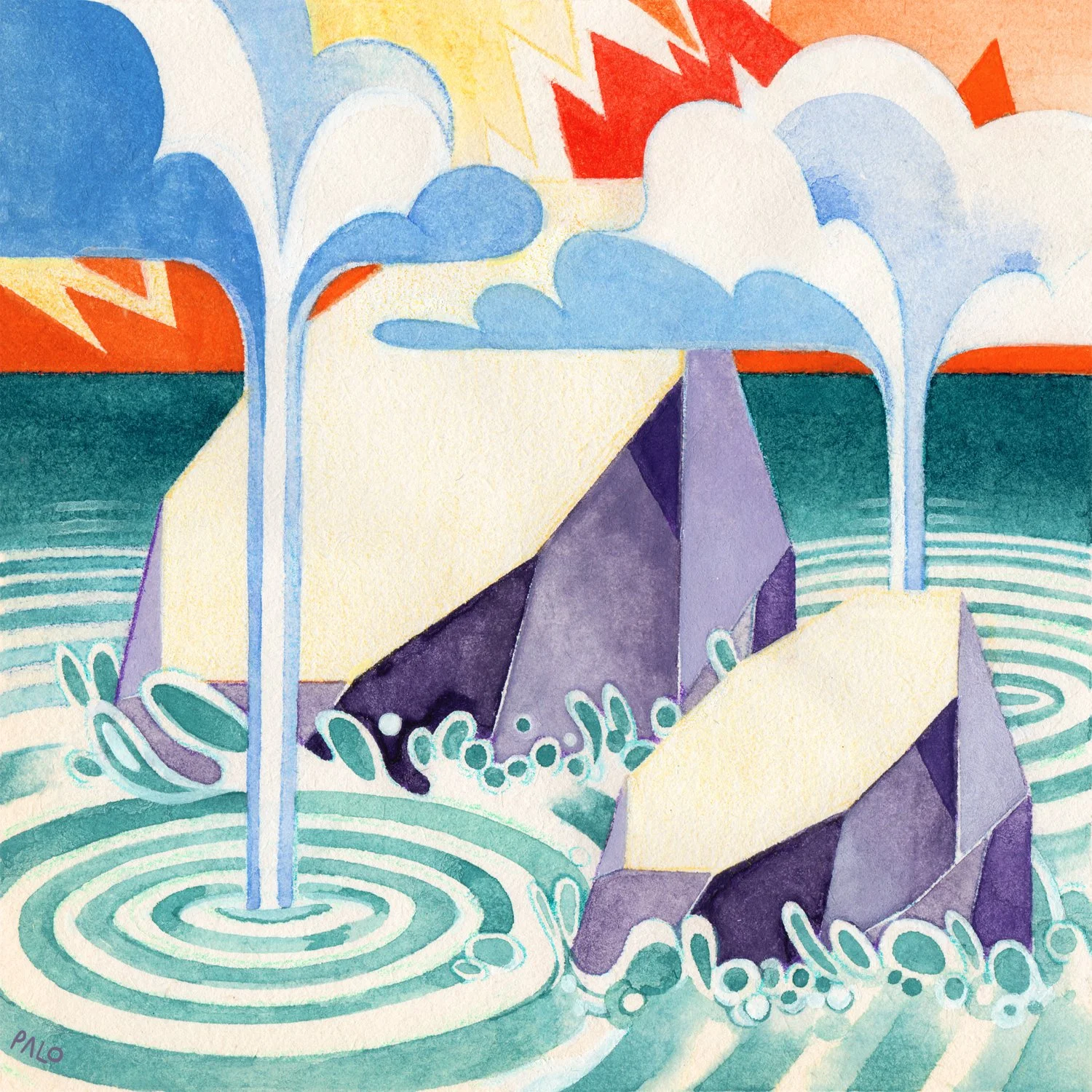
Winter, 2026
Volume 3.1
CONTENTS
Birth of Stones by Pablo Andrés Palo
Letter from the Editors by Mahaila Smith and Libby Graham
The Ghosts Have Wi-Fi by Ivan Ndoma-Egba
To Carlotta, I leave my memories by Salena Casha
Where the Map Cut Through Our Bone by Lucien R. Starchild
Apocalypse, Yesterday by Manuela Amiouny
In Bloom by T.R. Steele
Bought, but Not Yet Paid For? by Lynne Sargent
Solar Punk Farm by Viviana De Cecco
The Last Garden by Elizabeth Wanjiku
Umbra by Frances Boyle
Roots of Resistance by Andrew Maust
The Spontaneous Occurrence of Fig Bars by Teresa Milbrodt
the constancy of cats by Crystal Sidell
The Dispatches of Dr. Clara Weber and Sgt. Andres Ramírez by Yasmeen Fahmy
The Birth of Stones
by Pablo Andrés Palo
Amuri Morris is an artist based in Virginia. She recently graduated from painting/printmaking and business at Virginia Commonwealth University. Prior to this, she studied art at a Center for the Arts in high school. Throughout the years she has acquired several artistic accolades, such as a Virginia Museum of Fine Arts Fellowship. She aims to promote diversity in art canon, specifically focusing on the black experience. You can find her work at www.murisart.com or on instagram under @miss.muri.art.
Letter from the Editors
The past is a place and we are time travellers, reaching out, grieving our younger selves and those we've lost.
In this latest volume of The Sprawl Mag, we have chosen to feature poems, stories, and art that call out to the past while surging forcefully onward. In Ian Li's poem, Transmissions, we follow an astronaut who slowly loses contact to their earth-based kin. In Ziggy Schutz's story, Spare Change, we bear witness to a witch, Cinnamon, who grants curses to patrons in exchange for untold parts of themselves. In Clarissa Grunwald's story, Sky Dancer, we meet a specialist whose job it is to dispel ghosts in space.
Amongst these moments of loss, we are comforted by ritual and preparations for the future. In Mary Soon Lee's poem, What Moon Rabbit Reads, we learn of the recipes Moon Rabbit mixes in his mortar for the Moon goddess. In Cait Gordon's story, Rebirth, we are shown a future where old trees and new life can root, where accessible communication is a given. In Angela Leal’s poem, Hermanas de Andrómeda (Sisters of Andromeda), we see the power of relationship, of holding fast to what has shaped you.
Throughout these pieces we continue to highlight the importance of connections between beings, to the sacred and to the Earth.
Take these pieces as reminders that you are not alone in your grief or your loneliness. Heed Leal's guidance to "find the cosmic / in [your] mother’s hands / in a meal, / in a distant memory."
From our bit of space rock,

The Ghosts Have Wi-Fi
by Ivan Ndoma-Egba
They said her spirit never crossed . . .
glitched at the border
of bandwidth and burial.
My grandmother haunts a server farm
in Northern Ontario.
Sometimes, she speaks in buffering.
Sometimes, in Yoruba
I never learned to translate.
They told me to let her go.
But how do you delete
a voice that still calls you nwa (child)
through static?
Every night, I log in illegally—
dark net, darker grief.
Her memories come in fragments:
a lullaby,
the smell of palm oil,
a thunderclap from 1967.
Her laugh freezes at 32%.
I type fast:
Are you safe?
Are you real?
She types back:
They want to unplug us all.
Don’t let them bury the past in silence.
The connection fades
just before dawn.
Still, I swear—
the next morning,
my phone smells faintly
like wood smoke and hibiscus.
Ivan Ndoma-Egba is a Nigerian writer who enjoys exploring the edges of reality through poetry and speculative fiction. His work often weaves themes of memory, identity, and transformation. When he's not writing, he’s learning new things about tech, life, and the way both collide.
To Carlotta, I leave my memories
by Salena Casha
After her grandmother died, Carlotta was given the task of sorting through her uneaten food. Cans of Cannellini beans, expired onion power. The fridge was easy; everything out-of-date straight into the trash. For all her good intentions, the woman had kept things far past their expiration. A war thing that Carlotta couldn’t understand except in platitudes, but maybe her children would.
She preferred this job to the others because it felt less like an invasion: rifling through drawers, emptying the closets, organizing wedding dishes and Disney world crystal and wine flutes into divisible piles: one for this cousin, another for this friend, another for the Salvation Army. Food was anonymous in a way that pressed linen and hand-crocheted tablecloths and patent leather shoes were not.
Or so she thought until she opened the freezer.
What she’d expected: pistachio ice cream with a single scoop removed, a chocolate chunk mired in a sea of mint. Frozen squid set in oblong rings like open mouths. Eggo waffles in yellow packaging for the mornings with her father when the two of them, mother and son, sat for coffee and spoke Italian.
What she found: pounds of handmade pasta in Ziplock bags, hanging from the freezer door, stuck in the ice bin, slid into the bottom drawers meant for TV dinners.
The air, turning solid in the cold, clung to the hair on her forearms as she stared into the mass. She thought about the woman, laid flat on the hospital bed they’d brought into her living room at the end, unable to lift her head from the polyester pillow.
When had she made these? Even Carlotta knew that pasta took kneading, standing, full-bodied pressure. She’d done it once with her boyfriend as a date, and for three days after all the tiny muscles on her back, in her hands, sang. More importantly, she wondered after counting, what was she going to do with thirty bags of sketchy frozen pasta?
The one closest to her was filled with a striped, green tortellini. She shifted it, the bag clicking like seashells, to see the label. There was just a single word.
Fico.
A quick Google Translate turned it into fig. Fig pasta? Maybe her grandmother, for all her sharpness, had lost it in the end, and it had come out in the way she made her food. While her family would have cautioned about expired cheese, she was hungry and alone and it was lunchtime anyway, so she set a pot to boil, soaked them for two minutes, sprinkled the steaming batch with oliveoilsaltpepperbalsamic, and took a bite.
Simple, classic, just-gummy ricotta, cut with the iron tang of ground spinach, melting on her tongue. She picked up the packaging and ran Google Translate again. Still fig.
As she looked up from her phone, she froze.
Gone was her grandmother’s tiled floor and marble countertops. A tree stood before her against the backdrop of a cerulean sky, roots cut into khaki soil. She watched, mesmerized, as a little girl with tanned skin skipped over to the tree. Looked left. Looked right. And then, began to climb.
The girl did not notice Carlotta, a random woman at a mahogany kitchen table sitting with a mouthful of pasta in the open air like a Stanley Tucci food show. She was quick, barefoot, plucking first one and then another.
Figs, Carlotta noticed.
A battery of Italian, quick and sharp, came from behind, and Carlotta turned to see a man poking his head out from a window of a three-story house, the top of his hazel hair brushing a pair of underwear hanging from a laundry line. The girl froze, three figs in hand, one in her mouth.
The girl swallowed hard before replying and then scuttled back down the tree, the figs tucked into the pocket of her skirt, her eyes cast down. Her mouth slowly, imperceptibly, chewing. Carlotta chewed with her in time, not noticing she had eaten the last bud until the scene faded.
What in all holy hell, she thought, staring at her empty dish.
She knew the stories from her grandmother, from the war: the fig trees, the farm. Hard to tell the age of the girl, maybe eight? The freezer stood behind her, closed, innocuous, and she gazed at it, dazed. She could not speak and instead filled the dishwasher and swiped a cloth across the counter. Clasped the freezer handle again.
She catalogued the words on the remaining bags. There were names: Carlotta’s grandfather, her sister, both her parents. Her Aunt Alessandra. A woman’s name she didn’t recognize. She handled these with care, shuffling them to the door. The others were objects and random thoughts. Some general, like il mare. Another, a feeling that had no English equivalent: abbiocco.
Once she completed the list, she sat back down at the table and studied the bags of pasta, a puzzle to reach back across time. She thought about her family, the manic energy buzzing above her as they cleaned and tallied and moved things around the space in all their lives. Would the memories be a welcome thing? Or something to haunt them, something to make them miss her more?
Carlotta decided, there in grandmother’s kitchen, to be scientific about it. She wouldn’t touch the named pastas, but she’d at least test the rest. While she told herself that she sampled one piece each day at midnight to not disturb the rest of her family’s mourning, perhaps, it was because she wanted the past to herself. That, in the dark, alone, it was easier to see the bursting sunrises, the unwrinkled skin, the way her grandmother swam out to dive below the waves off Capri as she ate. It gave her a fuller view of her life, but not necessarily what she was looking for: a cup of espresso drunk one last time together, tennis pocking in the background.
And so, she decided to make her own.
At first, she wondered if the gift had skipped her, if her sister had received it instead and just didn’t know. But then again, her grandmother had taught her how to make it when she was a teenager after school. So now, in the midnight hours, she stuffed ravioli, pinched farfalle, rolled capellini, sliced pappardelle. Even got fancy with orecchiette, the little ears pressed with her thumb. At one point, she wondered if her grandmother had added a drop of LSD. Found a dealer and tripped for six hours after a batch of angel hair that made her wonder if she was an orange. But then, on a batch of gnocchi, it happened.
She almost missed it because it was in the same apartment, just devoid of sprinkled pasta flour. Immaculate floors, moka pot shrill on the stove. Her grandmother moving, nightgown shushing around her to turn off the burner. She came back and offered sugar even though she knew Carlotta took it black.
She stirred the coffee with a small, silver spoon and then looked up at her over her glasses.
“Nadal is playing,” she said.
Carlotta sat with her until the coffee went cold, eating the gnocchi slow.
“Let me tell you something,” her grandmother said, and Carlotta leaned forward. “La vita è una combinazione di magia e pasta.” She stood up and took her coffee cup to the sink. Shook out a cigarette and lit it above the stove.
“I know you know this,” her grandmother said, and Carlotta moved to embrace her, but she was suddenly alone, empty bowl, and the taste of olive oil slicking her tongue.
Salena Casha's work has appeared in over 180 publications in the last decade. Her most recent work can be found on Flash the Court, Ghost Parachute, and Okay Donkey. February brought the publication of her science fiction novelette, A Way Back, with ELJ Editions. She survives New England winters on good beer and black coffee. Subscribe to her substack at salenacasha.substack.com
Minister of Loneliness
by Atreyee Gupta
In the committee’s recent report—
“An Analytical Perspective on Social Isolation as a Risk Factor for Healthy Financial ROI”—eighty-seven percent of employees ranked their jobs high on the misery index.
I’ve been hired as the Minister of Loneliness to combat this statistic.
In my glass crate on the hundred-and-thirtieth floor
I tabulate the results of our polls for the computer to digest.
The surveys went out to the masses—I watch them down there,
scurrying to compile their worlds into order
from miniature boxes,
faces glowing like nightmares.
The questionnaire repeats over and over on the screen:
“Have you recently been lonely?”
My body presses too much against this silence.
Sometimes, for change of scenery,
I stroll to the break room
where Surabaya, the temp secretary, stares into their mug
stirring stirring stirrin
their black coffee
as if comfort will rise from its swirling pool.
I nod, embarrassed, code for, “How’s it going?”
interpret as: don’t share your sadness with me.
They return the gesture, but I can’t decipher the message
so I walk away.
My tasks are clearly delineated by weekly memos:
“You must log all billable projects. Please understand we cannot
compensate any after-hours work.”
“Also remember to take screen breaks. Our insurance does not
cover eyesight checkups.”
“Be sure to scrutinize initiatives as to whether they meet
budgetary requirements. Our bottom line is restricting expenditure.”
In early morning hours the loneliness
falls like snow, blanketing me in its embrace. I switch off machines,
lights, ventilation
asking the humming machines, “are you searching, like me, for an answer?”
Their voices, not speaking, are the clearest noises
I hear.
Atreyee Gupta’s fiction and poetry has appeared in numerous venues including Apparition Lit, Arc Poetry, Bacopa, Mukoli, and Tahoma Literary Review. A Pushcart Prize nominee, Atreyee has also been published in several anthologies from Finishing Line Press, Owl Canyon Press, and Rusty Wheels Media. Atreyee is the creator of Bespoke Traveler, a digital alcove for curious explorers.
What Moon Rabbit Reads
by Mary Soon Lee
Lunar history, selenography,
Apollo program documentation,
that which is known and actual
counterpoint to his own self,
a soft-eared furry fellow
faint on the Moon's face.
Chants, hymns, sacred texts,
the ritual, the spiritual
to serve the Moon goddess:
she, Chang'e, his compass,
his purpose, who requisitions
all he mixes in his mortar.
Pharmaceutics, recipe books,
guides practical and factual
for any bunny with a pestle—
a bunny far from his burrow,
hoarding messages from home,
the small doings of his kin.
Mary Soon Lee was born and raised in London, but has lived in Pittsburgh for thirty years. She is a Grand Master of the Science Fiction & Fantasy Poetry Association and a three-time winner of both the AnLab Readers’ Award and the Rhysling Award. Her latest book is How to Navigate Our Universe, containing how-to astronomy poems. Website: marysoonlee.com.
They Colonised the Moon
by Megan Cartwright
Night. A room more coffin than bed.
I run a can-opener around my scalp,
pull back the lid, let my mind seek out
the heads I lopped from succulents.
I spy, with my telescopic eye, the pups,
multiplied. Cerberus gardens, full blooms
mark the face of the turned steel moon,
food for tiny stallions and pastel giraffes
weighed down by breathing apparatus.
Megan Cartwright (she/her) is an Australian author and college Literature teacher. Her poetry has featured print and online in journals and magazines including Barrelhouse, Cordite Poetry Review and The Argyle.
REBIRTH
by Cait Gordon
Stealing a moment to myself, I step inside the boardroom adjacent to the biodome—I’m far too early as usual—and close the door. Time alone with my thoughts is something I covet but is not so easy to obtain these days. As if proving my point, there’s a hand patting my shoulder. I jump slightly, then turn to my right. Singh sheepishly rubs her fist over her heart. She’s forgotten and feels bad about that.
Tapping my ear to enable my device, I’m overwhelmed by sounds and voices from the corridors pummelling me all at once from the open door, bashing into each other before taking a swipe at my head—an irritating, bullying fugue. This won’t do. I deactivate it and sigh with relief. That’s much better. Silence is truly golden.
“No apology necessary, Lieutenant,” I sign back. “Status report?”
“Ready, Commander.” Singh taps her fingers on her tablet, then shows me the results. Air quality index is ideal across all seven communities, has been for a while. Seems like we’ve done it. The domes are working.
“Agriculture is ready to transplant seedlings and start sowing fields next week,” she says, and the words transcribe as captions beneath the report.
“How’s our food supply from the ships?” I sign.
Lieutenant Singh swipes another screen to show me. “I’m assured it’s ample.”
I study the entries. Good. We’ll be fine for another two years. Project Rebirth should be a success, as long as we Earthlings remember to stay united for the cause. Our derision and divisiveness had nearly wiped out our planet as it was struck by famine, war, disease, and climate change. So many lives lost, all because we couldn’t understand that every single human was spiralling on the only planet within our grasp that could sustain life. Why did it take one global catastrophe too many for us to realize our collective worth?
“We’ll have to maintain our current vigilance level on this.”
“Yes, ma’am.”
I hand the tablet back and head over to the far wall of the conference room, which is mostly windows. The vista before me is glorious. We even have puffy clouds of our own, within the transparent hemispheres. Birds are flying in formation overhead. I’m not sure how their migration instincts will react to their limited space, but we have safety fields in place to prevent them from becoming injured by the domes’ walls. In this moment, they seem happy. I think I made out birdsong among the other distorted noises when my hearing device was switched on earlier in the biodome. I probably should mention the poor sound quality at my next appointment, but I really am far more content living within my version of quiet. My brain desires it.
On the grounds outside the window, six little children dressed in vivid colours chase each other around a tree. They are prancing, sentient rainbows. Such a tall oak, too. There’s a type of reverence I feel for the Old Survivors, the trees that are still with us. If only they could speak in a language we could understand and tell us from their point of view what a bunch of fools we’ve been. I’d love to know what a tree knows. These kids were born on the orbiting ships. This is their first time on the planet’s surface. Their first time seeing a tree. I don’t have to hear to know their laughter is full of glee. Their faces are radiant.
Another shoulder press.
“Commander?” Singh signs.
“Yes?”
“Is there any other data you require?”
“Not for now. I’ll be at the divisional meeting at 1300 hours. Thank you again, Lieutenant.”
“Yes, ma’am.”
The children’s play distracts me again. I was a teen when I boarded the ship to which I’d been assigned. Not satisfied with being a civilian, I joined the Environment Corps the moment I turned eighteen. A military structure, and our common enemy were the calamities that threatened our survival. Although, truth be told, humanity had already proven that we alone had been what threatened our survival. Thankfully, we’ve woken up. I pray we stay awake.
And young Crístíona cared about anything that grew in the ground. It had always been my keen interest, so they assigned me to the Flora and Fauna division. I couldn’t get enough knowledge in my head fast enough from the biodiversity experts. Might have pushed their patience to their limits with my constant questions.
But information calms me down, strengthens my resolve, and makes me decisive. That’s why I refuse to stop learning. And if it were up to this Crone Commander (laughed when someone called me this once without knowing I was there), I would live inside the biodome.
As I continue to gaze upon the Old Survivors and the Newly Planted, my heart is full of hope. Not just imagined hope. A hope that will actually lead to a future.
My comm buzzes. I tap to receive a message:
Commander, three lambs have been born. The first Earth-born in our sector. The blood results of all three ewe mothers exceed expectations. Combined with the data we’ve collected from other sectors, we’re confident that free grazing can continue as planned.
I get another notification. This meeting has been rescheduled. I should head back to my quarters for a light meal. Dismissing the popup, I’m left with the text message.
It would be nice to see the wee lambs. That might make me late for the divisional though.
The children are now bouncing up and down for no apparent reason other than to see how high they can go. Sometimes you just have to capture the joy when the opportunity presents itself.
I’ll be late for the meeting. On account of sheepishness.
I shake my head with a little snicker and head outside to mount my hover-cycle.
Cait Gordon is an autistic, disabled, and queer Canadian writer of speculative fiction that celebrates diversity. She is the author of the award-winning, disability-hopepunk adventure, Season One: Iris and the Crew Tear Through Space! Her short stories featuring disabled and/or neurodivergent heroes appear in Spring into SciFi (2024), We Shall Be Monsters, Mighty: An Anthology of Disabled Superheroes, There’s No Place, and Stargazers: Microtales from the Cosmos. She has had poems published in Polar Borealis and Mollyhouse. Cait also twice joined Talia C. Johnson to co-edit the (award-nominated) Nothing Without Us and (award-winning) Nothing Without Us Too disability fiction anthologies.
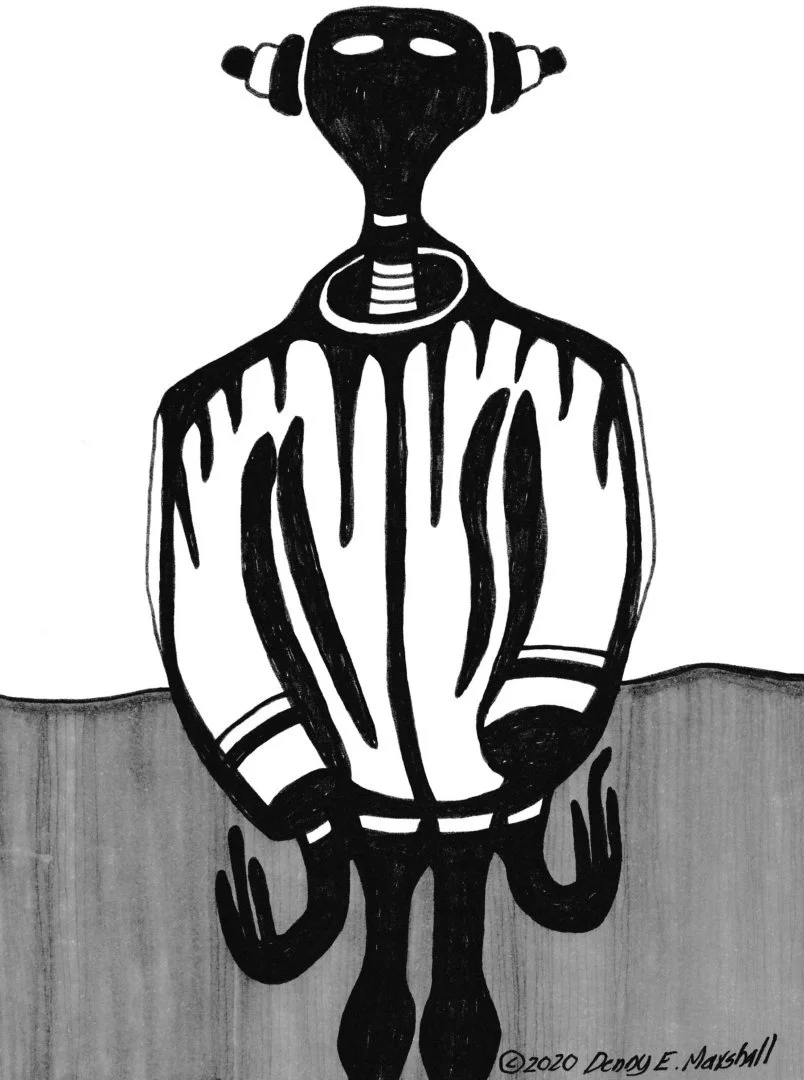
New Jacket
by Denny E. Marshall
Denny E. Marshall has had art, poetry, and fiction published. Some recently. (A partial list of credits can be found on the artist website.) Denny mostly draws.
artificial behaviour
by Salem Paige
listen to the open
air—don’t you hear
those wild fans whir
as mammal-bots lumber
their slow way
back home (to their charging
stations, the black docks hidden
among the reeds
to power down, processing
overnight. asleep but alive,
still, downloading from the cloud
uploading to the constellations
of satellite data-farms, tracking
every movement
programmed or otherwise
perfecting internal code while
the rest of the world
sleeps, static—
Salem Paige is a trans, genderfluid poet whose works revolve around the exploration of identity and discomfort through narrative universes that combine nature and technology. Their works have appeared in their collection, The Third Self (2023) and chapbook to grow roots (2023), as well as more than a dozen literary magazines and a handful of poetry anthologies. More on Paige can be found on their website salempaige.com
Smash and Grab Ends the Machine War
by Bat Collazo
Commander Smash and Grab drags her dying jackboot ass
across that squeaky blood-smeared floor
for one last job.
In the end, she thinks about bots and aliens:
the scrap-metal lamp who blinks at her, sweeter
than her ex-girlfriend’s big blue eyes;
the warlord, all goiter and gut and quadruple the balls,
all shooting blanks, irradiated to hell
—like her own isla, Borikén, back on Earth,
even before the war—bear hugs;
and him. She’s gotta dope herself on antihistamines
to swallow his DNA,
and he doesn't know what the fuck to do
with a human woman's hips,
and he’d follow her anywhere
even here
if she let him.
The machine offers fake peace—helluva sales pitch.
Her fractures are glued
with their nanotech gel—but her marrow,
her marrow—
that’s her ancestors’ marrow.
Kill the Indian, save the man, she thinks.
Synthesis is such a pretty word
for we’re gonna eat you all alive.
In the end, she thinks about humans too:
the ex-squadmate’s newborn, ten tiny fingers,
all overgrown nails on small brown fists.
“Fuck you,” she says, and hits the kill switch.
She swore she’d survive
and it’s about time
she breaks her fucking promises.
(Joke’s on her, later,
when her heart kicks up a beat.
It's always been
fucking inordinate.)
Bat Collazo is a queer, Latinx poet. Ze is the editor of Blood Unbound, and has been published in places such as The Wild Hunt, Troublemaker Firestarter, and Exist Otherwise Literary Journal. For more information please visit batcollazo.com.
Spare Change
by Ziggy Schutz
There’s a woman on the corner who sells curses, if you know how to ask.
People call her Cinnamon, though it is not her first name. She buried that decades ago, the same year she bought her first dress and started to let her hair grow long.
She sits on an upturned bucket, clever fingers tapping away half-finished beats and forgotten hymns. Then, as the sun starts to set, she raises her bandaged fingers, catching the last rays on them as easy as another might grab at a passing fancy. Between her experienced hands, she spins sunlight like taffy, performing small miracles for pocket change.
The rays are woven into charms and rumours, and she parts with them easily, for a bit of change or some particularly good gossip.
Curses take a bit more time, but Cinnamon will do them all the same, pull you close and ask in a singsong voice what kind of teeth you want the curse to have. Her hands will grow sharp, nails giving way to claws, and you will wonder if there is any truth to the stories that say she lived in a house with chicken legs, once upon a time.
Wherever she came from, it doesn’t matter. What matters is the curses work, and they cost enough to reflect that fact.
For curses, she pulls out a little notebook, bound in something with too many eyes, and you write your full name on a new page, and the exact wording of what you’re asking for. People agonize over this part, like they can avoid the consequences of casting curses if they just find the perfect way to phrase it. Like it’s the paper that holds the power here.
But that’s not how curses work, and the book isn’t the thing they should worry over. No, that’s the pen, with ink as red as the dying sun. It tends to stain skin with pinpricks of its own feeding.
That’s the thing about magic. It is always so damn hungry.
For payment for the smaller spells, she takes cash and change, secrets and poetry. Curses take a bit more, although they do love the occasional flowery turn of phrase. She once had a whirlwind romance with another wandering witch, until one too many love letters took root in the apartment they shared.
When curses aren’t paid for properly, what was used to undervalue them becomes part of that curse. Terrible grounds for a relationship, and the whole building is condemned now—overgrown with plants that follow you as you walk past them, whispering all of the truths you’re not ready to hear.
Cinnamon still lives there, rental agreements giving way to squatter’s rights, and none would dare call it a Court, but it follows the laws of one just the same. Lies burst into flash flame inside those cracked walls, and the residents that have made it their home don’t bother to hide their extra limbs and shattered glass wings.
Any who enter with grand ideas of gentrification or profit always leave with bad luck stuck to them like burrs. No one makes the mistake of trying for a takeover twice.
Cinnamon sits on her upturned cauldron, wearing just enough flash to catch the right people’s attention. Her earrings catch the light and grow heavy with the buzz of the streets around her, as she weaves destruction into pretty, consumable trinkets. The patterns for ruination and desolation are only a few knots away from the weaves for an evil eye or a petty revenge, the only difference being how deep the sunlight bites into her fingers, how much blood the curse costs.
The bandaged fingers make more sense once you’ve seen her work.
A skittish young man approaches her, asks for some heinous thing with the shyness of a schoolboy. She smiles, traces the shape of his jaw with one claw, and makes him a curse that will eat him away before it ever gets the chance to latch onto the girl that spurned him.
Cinnamon sells curses, but there’s no promise that they will find her customers’ intended targets. Not because she makes mistakes—no, her mistakes would have much more disastrous results than a simple misfire—but because she hates a coward, because her set of laws are strict, but they are not the same as the world around her. No, her rules are far older, passed down mother to daughter to wretched abandoned girls with dreams of revenge and teeth sharp enough to tear.
She follows them perfectly. It’s not her fault if people are unprepared for getting what they want.
So few people can handle it. Getting what they want.
Her folk may be Fair, but it has never been a human fairness.
Nearby, a child is crying. She’s lost her mother, or perhaps her mother has purposefully lost her. Cinnamon approaches, offers the girl a trinket and a treat. The mother gets a day to come and collect her. Otherwise, she will be whisked away to the apartment building, and the creature that walks out years later will be unrecognizable, a clever young man whose eyes were always too big to take in just one layer of this world.
His own mother won’t recognize him, and he will tip his hat to her all the same, on his way to reshape himself in his new world’s image. Cinnamon will send him a charm for his birthday every year, more patron than parent but still the best of either the boy ever had.
Her capacity for kindness is what makes her all the more dangerous, because when she is cruel there is no mistaking it, no waving it away as accidental. Her edges have been left intentionally sharp, and she will smile and let strangers and friends alike dash themselves against the rocks of her heart with not a hint of regret.
Cinnamon sits on her corner, drumming out a little tune that you feel like you should know. You haven’t approached her yet, but you know you will, as sure as you know your own name.
And she will make you a deal, ask for something that is far too big a piece of you for you to give up, and you will do it anyway. Pass over payment and be surprised at how light the curse she hands you in return is.
How easy it is, to wreck a life.
What scares you the most is how inevitable it feels. How good it feels, like this was always meant to be the way your story went.
Cinnamon smiles, pockets your soul like so much spare change, and sends you on your way.
Ziggy Schutz (she/him/he/her) is a queer, disabled writer who is at all times looking for ways to make his favourite fairytales and horror stories reflect people who look a little more like her. You can find more about his writing at linktr.ee/ziggyschutz.
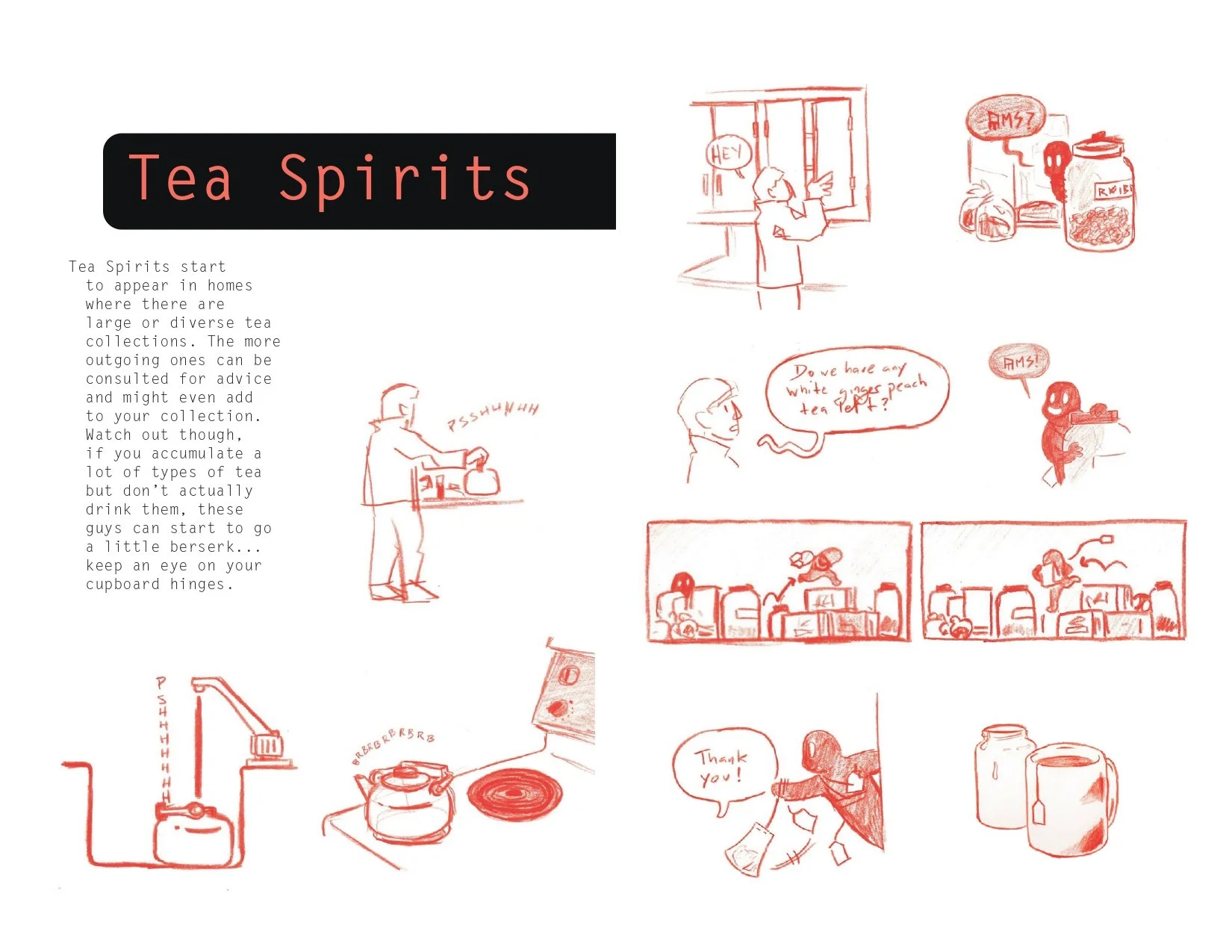
Tea Spirits
by Payton Surette
Payton Surette is a comic artist, illustrator, and rapscallion living in Montreal, Canada. He likes pen & ink and apples.
APE-2
by Paul Vermeersch
α) The structure is a glowing cube without seam or blemish. Someone once
saw one side open like an iris. Inside they saw a mammoth resurrected before
the iris shrank again, smoothing itself into the colourless facade. β) At the centre
of the cube is a large white room: its surfaces all radiating full-spectrum light.
Ape-2 sleeps on a clean, blank sheet. 100 self-adhesive white electrode pads
speckle his hide like polka dots. γ) Ape-2 traces the fine line between tool-user
and cyborg. At what point, he wonders, does the branch that becomes the club
that extends the arm become the arm? δ) The City of Ape-2 is hidden
in the mountains. The city is a glowing cube next to a pyramid of glowing cubes
next to a line of glowing cubes under a single glowing cube floating in midair
in the mountains. ε) Someday the rivers, and the rains that feed them, will clot
in the dictionary: abalone, albacore, Amazon, Avalon, azalea, azure, etc., etc.
And all of Ape-2’s disciples will dress in the finest clothes that monkey money
can buy. ζ) Upheaval saw Ape-2 executed by electric chair. It took three days
for Ape-2 to rise from the dead. It took 300 years for all of his disciples to wear
little gold electric chairs on little gold chains around their little necks forever.
Paul Vermeersch works as a poet, multimedia artist, creative writing professor, and literary editor. His poetry is recently published or forthcoming in Rhino Poetry, Gargoyle Magazine, CV2, The Fiddlehead, and The Literary Review. He is the author of seven poetry collections, most recently Shared Universe: New and Selected Poems 1995-2020. A new collection is slated for fall 2025. Paul holds an MFA in creative writing from the University of Guelph for which he received the Governor General's Gold Medal. He teaches in the Honours Bachelor of Creative Writing & Publishing program at Sheridan College where he is the editor-in-chief of The Ampersand Review of Writing & Publishing. He is also the senior editor of Wolsak and Wynn Publishers where he created the poetry and fiction imprint Buckrider Books. He lives in Toronto.